
Scan and solve
A solution you can follow, not just an answer
Every solve shows the givens, the relationship chosen and why, the unit conversions, and the boxed result. The point is the method; the answer is the by-product.
Chemistry AI tutor for iPhone
Photograph a problem and Flasky shows the givens, the relationship and why, the conversions, and the answer with units. Ask about any step, then drill it with quizzes and flashcards until you can do it alone.
Free to download. General to organic chemistry, high school through intro college.
Worked example
Ammonia is made by N₂(g) + 3H₂(g) → 2NH₃(g). A run starts with 25.0 g of N₂ and excess hydrogen, and isolates 24.0 g of ammonia. What is the percent yield?
Formula guides
What the formula says, what every symbol means, when you are allowed to use it, a problem worked all the way through, and the mistakes that cost the marks.
%X = (mass X / mass compound) × 100% percent yield = (actual yield / theoretical yield) × 100% compare n(X) / coefficient(X) across reactants; the smallest value is limiting M = Σ (atoms of each element × atomic mass) n = molar mass / empirical formula mass 1s 2s 2p 3s 3p 4s 3d 4p 5s 4d 5p 6s 4f 5d 6p 7s 5f 6d 7p 1 count valence electrons, 2 connect atoms with single bonds, 3 complete octets on outer atoms, 4 put leftovers on the central atom, 5 form multiple bonds if the central atom is short ΔEN = |EN(A) - EN(B)| How it works
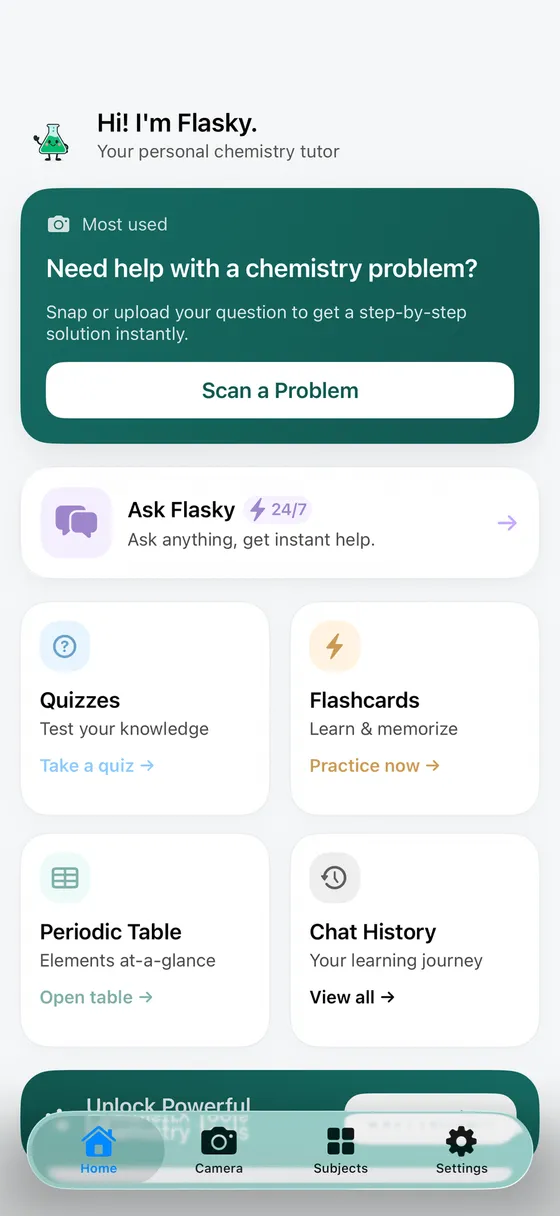
Point the camera at the textbook or the worksheet and crop to one problem. Flasky reads it and starts a solution with the reasoning shown line by line.
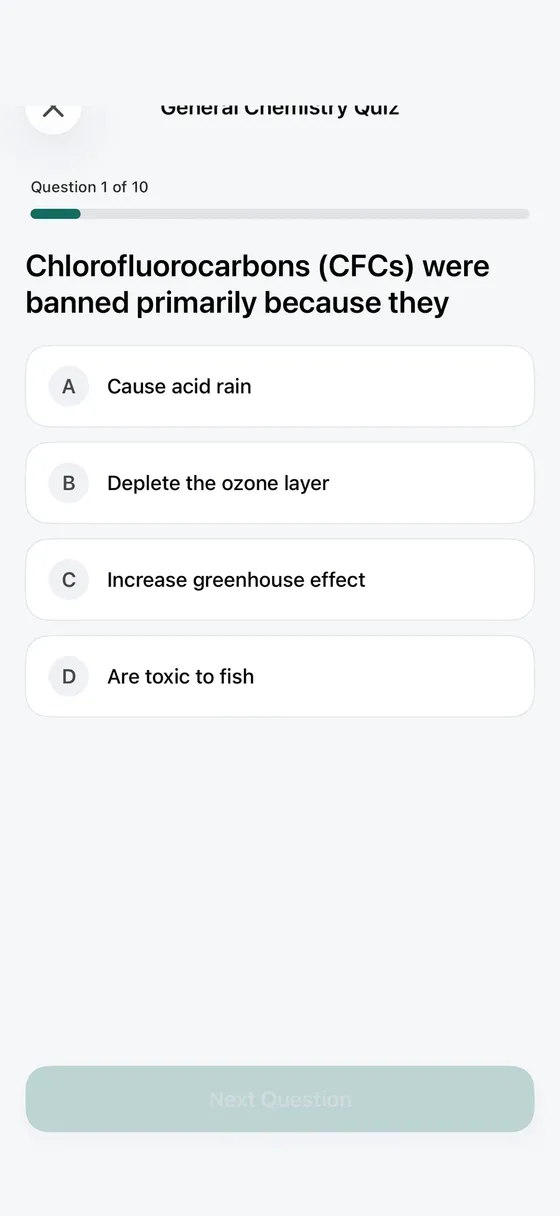
Quizzes by branch, from general to organic to physical chemistry, with instant feedback, and flashcards for the constants and definitions you keep forgetting. Both work offline.
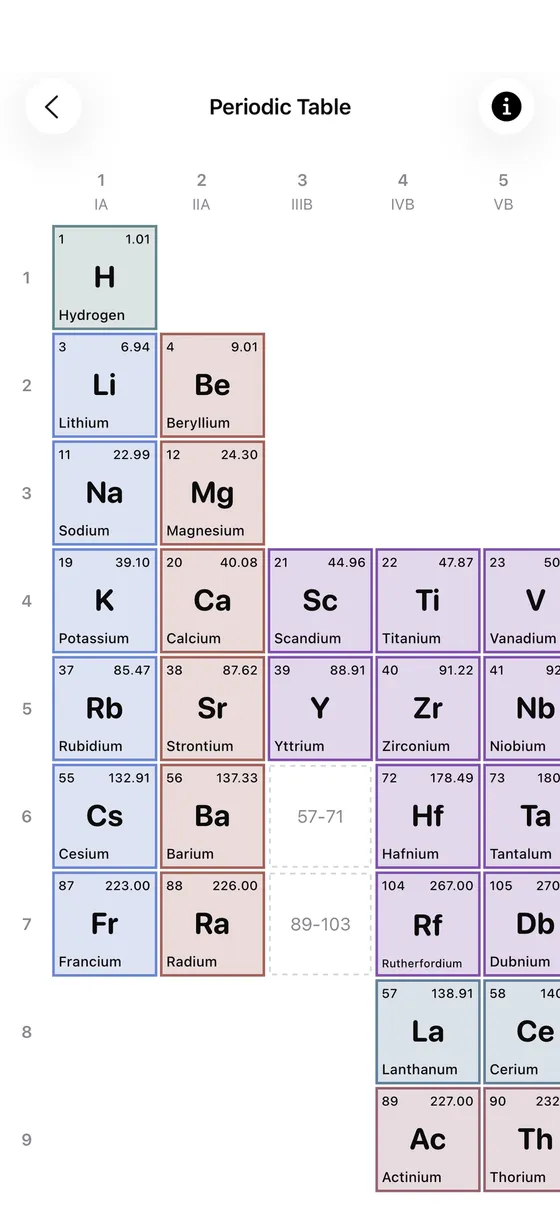
An offline interactive periodic table with element trends, properties and symbols, for the lookup you need mid-problem without leaving the app.
What is in the app
Everything a chemistry course asks of you, in one place, with the reasoning always visible.
Every solve shows the givens, the relationship chosen and why, the unit conversions, and the boxed result. The point is the method; the answer is the by-product.
Reaction mechanisms, a stuck step in a stoichiometry problem, why a buffer works. Chat history keeps every thread so you can pick a problem back up.
General, organic, inorganic and physical chemistry. Each question explains the right answer, not just marks the wrong one, and the whole set works without a connection.
Cards come back for what you missed, so the relations you need under time pressure are the ones you have seen most. Offline too.
Difficulty adapts to where you are. AP and A-level students and first-year undergraduates see problems pitched at their course, not a generic pool.
Symbols, atomic numbers, masses and the properties that matter, plus the trends across a period and down a group. Works with no signal, in the exam-prep corner of the library.
Questions
No, and it is built not to be. Every solution shows its reasoning step by step so you can see how the method works and reproduce it yourself. If you only want a number, a calculator is faster.
General chemistry (stoichiometry, bonding, solutions, acids and bases, gases, thermodynamics, kinetics, equilibrium), organic chemistry (mechanisms, functional groups), inorganic and physical chemistry. High-school and introductory college level.
Yes, from a clear photo. Crop to a single problem, keep the page flat and well lit, and Flasky reads the text, the equation and any given values.
Solutions are AI-generated and can contain a mistake, which is exactly why every step is visible. Ask in chat about the step you doubt; Flasky re-derives it. The formula pages on this site are verified against open textbooks and show every worked example recomputed.
Free to download, with the quizzes, flashcards and periodic table included. Photo solving and the chat tutor need a subscription, which the app offers inside.

Free to download on iPhone. Quizzes and flashcards are included; photo solving and chat are the subscription.
Free to download